
On July 15th, Michael Mackenzie-Shreenan posted an article ‘Waterloo: When Did Solidarity Stop Listening?’ criticising the Save Waterloo Encampment on his blog site. Shreenan is the Executive Officer at Counterpoint Community Services, a NGO that operates a tenant service centre in Waterloo.
The article was also sent through the local Redfern resident group RedWatch’s email list. Homes NSW also distributed a newsletter containing a ‘Rumours Corner’, which it says corrects “misinformation” circulating in Waterloo.
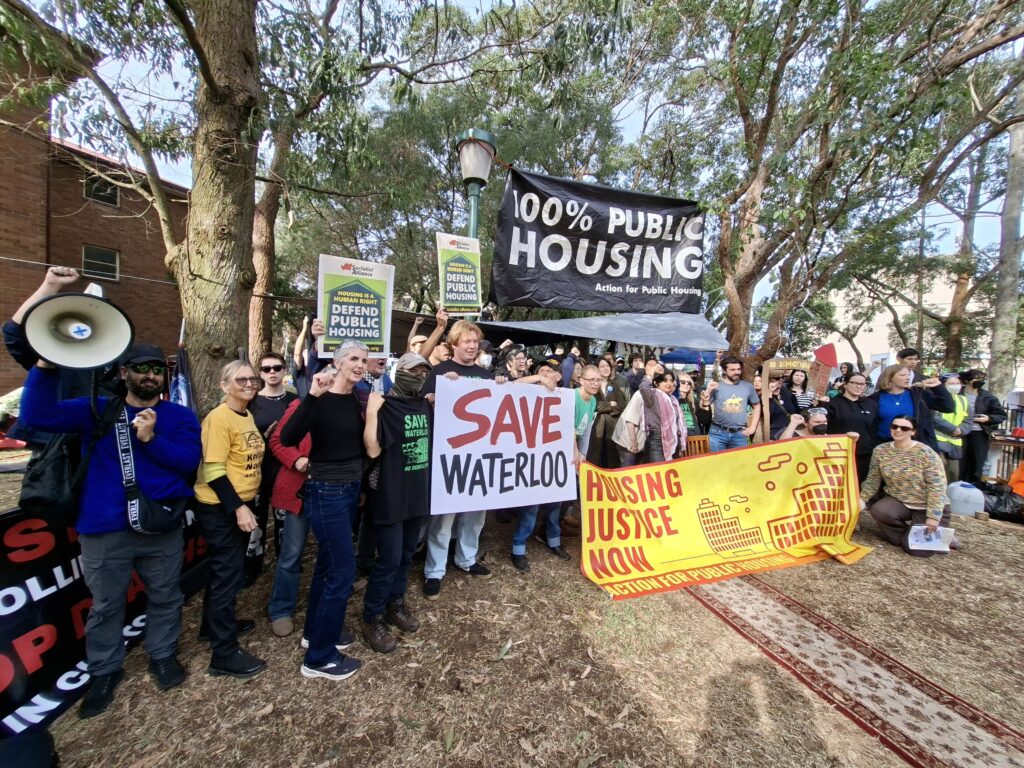
Action for Public Housing, a grassroots group campaigning to save Waterloo from demolition and its tenants from eviction, helped lead the month-long Waterloo Encampment.
Below is our response to Mackenzie-Shreenan’s and Homes NSW’s criticisms.
Saving Waterloo: the facts of the campaign to date
The Save Waterloo Encampment was a 26-day community protest camp in Sydney. Public housing tenants and campaigners occupied the Waterloo South estate starting on May 24th 2026, to stop the NSW Labor government’s demolition of Stage 1 of the estate and redevelop the public housing area. Police and riot squads cleared the encampment on June 19th 2026.
The month-long occupation of public housing land at Waterloo forced an issue that governments want to ignore: why is the NSW Labor government demolishing and privatising public housing during the worst housing crisis in generations?
The encampment attracted significant media attention and brought together public housing tenants, housing campaigners, trade unionists, First Nations leaders, unhoused people, socialists, anarchists, Greens, Labor members and members of Sydney’s queer and trans communities.
We were united around a simple aim: to save Waterloo from demolition and defend and extend public housing.
Addressing the claims
Mackenzie-Shreenan’s article implies public housing tenants weren’t involved in the encampment and outside activists caused unnecessary fear. He implied it was simply “webcam activism” and posited the demand “refurbish, don’t demolish Waterloo” was merely a slogan without an alternative behind it. He threw cold water on the protest asking, “what exactly was achieved?”
Firstly, it’s critical we don’t invisibilize public housing tenants, as governments do.
Tenants led the Encampment and were involved in meetings, actions and media conferences throughout the key month of actions. Like most people, tenants lead busy lives and hence called upon community allies to support them in initiating and sustaining the Encampment. Waterloo tenants opposing the demolition continue to meet weekly.
Secondly, serious alternatives to demolishing public housing already exist.
Shelter NSW commissioned economists Cameron Murray and Peter Phibbs to examine the economics of Waterloo redevelopment. Their 2021 report, ‘Reimagining the Economics of Public Housing at Waterloo’, challenged the assumption that the government needs to surrender public land to private developers to finance new housing. They argue the government is unusually well placed to retain development risk and long-term ownership, and examined models capable of producing substantially more publicly controlled housing.
More recently, the ‘Retain, Repair, Reinvest project for Waterloo North and Central’ by architecture and design firm OFFICE, examined refurbishment and infill as an alternative to wholesale demolition. The work found that retaining and upgrading existing buildings could reduce relocation, preserve community connections, lower embodied carbon and allow savings to be reinvested in better public housing.
Action for Public Housing organised a well attended public forum about the RRR report which received support from residents, one writing an article in the South Sydney Herald. We have asked for nearby vacant public land to have new public housing built on it, such as 600 Elizabeth St Redfern, North Eveleigh, and the former Camperdown WestConnex Dive Site.
These are hardly extremist demands.
Finally, the recent Encampment and ten year fight to save Waterloo has resulted in many small concessions from state governments. More on these below.
Homes NSW’s straw man attack
Homes NSW has since distributed a newsletter containing a “Rumours Corner”, which it says corrects “misinformation” circulating in Waterloo. It rebuts claims that Waterloo South will be replaced “only with private housing”, that tenants will simply be evicted into homelessness, that tenants have no right to return and that residents have received no information about the project.
There is one problem: these are not the arguments Action for Public Housing has been making.
We have never claimed every new home at Waterloo South will be privately owned. Our objection is that only about 30 per cent of finished estate will remain government-owned public housing, and that even those homes will have their management outsourced to private community housing providers.
Homes NSW itself now describes the project as “about” 3300 homes: “around” 1050 government-owned social homes, “around” 700 affordable homes and “around” 1550 private homes. These words matter. Governments routinely advertise the highest possible housing yields years before projects are completed, while details like floor space and number of bedrooms remain subject to market conditions.
More importantly, the argument about Waterloo has never simply been about counting apartments. It is about ownership and control of public land.
Before the 2023 election, local Labor MP Ron Hoenig campaigned against selling Waterloo public housing land. NSW Labor’s 2022 state conference adopted a policy calling for a moratorium on the privatisation of public housing, including its sale, outsourcing or leasing. Yet Labor subsequently proceeded with the Waterloo South redevelopment.
The umbrella term “social housing” does not make the distinction between public and community housing disappear. It is being used to mask privatisation. Community housing providers may be not-for-profit, but their CEO’s, drawn mostly from the top echelons of big business, earn huge salaries paid for by their low income tenants. Genuine community housing has the tenants running things themselves, as is seen in a number of NSW’s successful co-operative housing projects.
Nor have we claimed that every relocated tenant will inevitably become homeless. We have said something much simpler: forcing people from secure homes, sometimes after decades in the same neighbourhood, causes displacement and destroys community connections. A contractual “right to return” years into the future does not undo that disruption.
What the protest achieved
Contrary to Mackenzie-Shreenan’s argument that the Encampment didn’t achieve anything, it clearly did. Why else is Homes NSW frantically letterboxing tenants and Mackenzie-Shreenan slaving over a position piece?
The Encampment catapulted Waterloo and the bankruptcy of demolishing public housing in a housing crisis, into national discussion. It gave confidence to tenants to come forward and tell stories of forced eviction and the destruction of their communities into newspapers, television and radio and forced ministers to respond publicly.
During the period of the campaign, the government announced additional permanent crisis accommodation, including the refurbishment of existing government housing stock, and accelerated other homelessness projects. We won housing for one rough sleeper who came to the Encampment seeking company and support. The ACTU came out calling for a massive public housing build.
We also won a massive step forward for justice with the NSW government announcing mental health responders that will replace police attending certain mental health incidences – an issue that strongly impacts public housing residents.
We welcome every additional bed, every renovated government home and every person given proper support.
This tenant empowerment, community engagement and media scrutiny, forced political attention and raised questions about relocation, public housing and the human consequences of redevelopment.
That is what protests do.
Webcam activism or community empowerment?
The camp itself was much more than “webcam activism”. Thousands of dollars were raised to sustain it. Volunteers cooked and distributed free meals. There were discussions, films, classes, music and a fire around which tenants, rough sleepers, neighbours and supporters could sit together. For four weeks, people created precisely the sort of mutual support and companionship that critics of confrontational politics often say they want to see.
We formed a cohesive coalition of protesters, with active engagement by the Maritime Union Australia Sydney branch, Sydney University Student Representative Council, UNSW SRC (Arc Student Life), and over thirty key resident, housing, community groups and political parties.
This united-front campaign worked because groups and people with different traditions cooperated around solving the housing crisis by refurbishing, not demolishing public housing and demanding the government build more of it.
Waterloo Campaign History
There is also a longer history that should not be forgotten. Waterloo residents have resisted displacement before. In the 1970s, residents fought Housing Commission plans to demolish more of the suburb for high-rise redevelopment, including through occupations and the wider Green Bans movement. That struggle helped force a change of course: instead of extending the high-rise model across eastern Waterloo, the government agreed to retain and renovate existing homes and pursue more sympathetic infill housing, including developments such as Dobell and Drysdale, sisters to the Rocks’ much loved Sirius building.
Earlier still, during the Depression, the Unemployed Workers Movement organised militant resistance to evictions across working-class Sydney, including the inner-city districts around Erskineville, Newtown and Redfern. Those struggles put direct pressure on governments, including Jack Lang’s Labor government, for greater relief and protection for unemployed and working-class tenants.
Seen against a century of housing activism in NSW, the Waterloo camp was hardly an aberration or an exercise in “activist theatre”. It operated at the point where government policy has its most immediate human consequences, in an honourable tradition of tenants and communities refusing to wait politely while their homes are taken from them. By that historical measure, direct action, community organising and broad alliances are not irresponsible deviations; they are among the practices that have repeatedly saved low-cost housing, changed government policy and produced better outcomes.
We won’t stop
The ALP State government is currently demolishing Stage 1 of the Waterloo estate, with loud bulldozers taking down trees and apartment blocks. Action for Public Housing are campaigning for them to stop immediately, retain and maintain it, and renovate and retrofit it to modern standards, along with the rest of Waterloo estate.
Where additional homes can be sensitively added, they should be public housing. Residents should not have to leave their local community simply because the NSW government neglected maintenance for decades. Public land should not have to be sold, leased away or outsourced to make decent housing possible.
Mackenzie-Shreenan’s suggestion that the redevelopment debate has simply “moved on” is also revealing. Governments frequently tell communities that resistance has become pointless once enough bureaucratic decisions have been made. But demolition and privatisation are political choices, not forces of nature.
Waterloo South is only part of the wider estate. The government wants to sell off Waterloo North and Central too. That is why we have to keep campaigning.
We welcome genuine discussion about how to win housing justice struggles. We welcome evidence, competing plans and discussion with residents. But criticism should address what campaigners actually say, rather than positions invented for them.
The housing crisis makes the principle more important, not less: public housing land should remain public, existing communities should be protected, and governments should build and renovate public housing rather than treating it as a source of land for private development.
The Waterloo occupation did not win everything we wanted. But it demonstrated that resistance can engage tenants, change the political conversation, win concessions and bring together people who refuse to accept that the destruction of public housing is inevitable.
We intend to keep organising — in Waterloo and everywhere else public housing is under threat. Please get involved, sign our Save Waterloo petition, come to a tenant meeting, or help with our upcoming Save Waterloo banner drop on the first weekend of September.
Thanks for taking the time to respond.
While I welcome debate, much of this article seems to respond to arguments I didn’t actually make.
I never argued that Waterloo tenants weren’t involved in the encampment. In fact, I explicitly acknowledged tenant participation and recognised the significant commitment many activists made because they genuinely care about residents.
I also find it a little curious to be criticised for supposedly dismissing alternative proposals when I have consistently supported deeper examination of alternatives, supported resident involvement in that work, advocated for greater scrutiny of redevelopment decisions, challenged the sale of public land, and supported efforts to secure funding for research now cited in this response.
Apparently I’ve now become the bloke who opposes alternative options. That’s news to me.
What surprised me most, though, is that much of this response focuses on proving points that were never really in dispute.
My article acknowledged the campaign’s achievements. It acknowledged tenant involvement. It acknowledged the role activists played in drawing attention to important issues.
The questions I raised were different.
Who speaks for Waterloo?
How does any campaign demonstrate it speaks for the broader resident community, including residents who disagree, residents who are undecided, and residents who want practical support rather than political mobilisation?
What accountability applies when concerns are raised about behaviour, hostility towards workers or public servants, intimidation, or conduct that leaves some residents feeling pressured rather than supported?
What responsibility exists when messaging increases fear and anxiety amongst people who are already living with significant uncertainty?
The response spends a lot of time explaining why the campaign believes it was right.
It spends considerably less time examining whether everything done in the name of being right was justified.
Having a good cause doesn’t give anyone a free pass.
Not governments.
Not community organisations.
Not activists.
And certainly not me.
My concern has never been whether people care. I think many clearly do.
My concern is whether caring exempts anyone from scrutiny.
It doesn’t.
Anyway, thanks again for the response. If anyone would like to continue the conversation in person rather than through competing blog posts, I’ll be in the city for my end-of-month drinks. Feel free to join me for a yarn… Just leave the placards at home. 🍺